THE ARCTIC RACE: HOW RUSSIA AND CHINA POSITIONED WHILE THE WEST SLEPT
The Flag That Changed Everything
In August 2007, Russian polar explorer Artur Chilingarov descended to the Arctic seabed and planted a titanium flag at the North Pole. Western media treated it as theater. It wasn’t. That same week, Russia resumed strategic bomber and Northern Fleet patrols in Arctic waters for the first time since the Cold War ended. The Northern Fleet, Russia’s most powerful naval asset with the greatest concentration of icebreakers and submarines, began expanded patrols near Norwegian and Danish territories. The sea-based nuclear deterrence capability positioned in the Arctic became fundamental to Russia’s military doctrine.
Chilingarov’s statement was explicit: “The Arctic is Russian. We must prove the North Pole is an extension of the Russian coastal shelf. Russia does not need to negotiate further but should simply continue working towards proving its claims.” This wasn’t rhetoric. It was strategic doctrine being announced in real time.
One year later, in September 2008, President Dmitry Medvedev approved Russia’s comprehensive Arctic policy document: “Foundations of the State Policy of the Russian Federation in the Arctic for the Period Until 2020 and Beyond.” The strategy declared that all Arctic activities should be tied to defense and security interests “to the maximum degree.” The document prioritized the Northern Fleet’s nuclear forces for deterring threats against Russia and its allies. It outlined specific phases: 2008-2010 would focus on geological surveys, mapping external Arctic borders, and establishing industrial-power clusters. The Arctic was defined explicitly as Russia’s primary strategic resource base for economic growth.
By 2008, Russia controlled 53% of the Arctic coastline. Of the four million people living in the Arctic, two million were Russian. The Northern Fleet already operated 35 submarines and six missile cruisers. Russia’s nuclear icebreaker fleet had been operational since 1960 when the Lenin first broke ice in the Northern Sea Route. The infrastructure, the doctrine, and the intent were clear. The West largely ignored it.
China’s Quiet Entry: The 2012-2013 Pivot
While Russia positioned militarily, China positioned diplomatically and economically. In August 2012, the Chinese icebreaker Xue Long became the first Chinese vessel to traverse the Northern Sea Route. This wasn’t a scientific curiosity. It was a proof of concept for what would become the Polar Silk Road.
That same year, China dramatically increased Arctic spending and initiated serious discussions about the Yamal LNG project with Russia. Then in May 2013, after a six-year application process, China gained permanent observer status in the Arctic Council. The response was immediate and calculated. Within weeks of gaining observer status, Yu Zhengsheng, Chairman of China’s Political Consultative Conference, visited Finland, Sweden, and Denmark to boost Arctic cooperation. China announced an expanded polar research institute that would collaborate with Nordic research centers. The message was clear: China did not intend to be a passive observer.
The self-designation as a “near-Arctic state” was geographic absurdity but political brilliance. China has zero Arctic territory, yet it successfully positioned itself as an Arctic stakeholder. In 2014, Xi Jinping announced China’s ambition to become a “major polar power” as an important component of becoming a great maritime power. The Arctic was formally incorporated into the Belt and Road Initiative as the Polar Silk Road.
From 2012 to 2017, China invested an estimated 90 billion dollars in Arctic states according to Secretary of State Mike Pompeo’s later accounting. The spending bought influence, infrastructure access, and strategic positioning. The civil-military fusion strategy was evident in every investment. Research stations went up across the Nordic region: the Yellow River Station on Svalbard in 2004, the China-Iceland Arctic Observatory in 2016, the Arctic Remote Sensing Satellite Ground Station in Kiruna, Sweden in 2017, and the Greenland Satellite Ground Station in Kangerlussuaq in 2017. Each one served scientific purposes. Each one also provided dual-use capabilities for surveillance, communications, and military applications.
2012: The Year the Arctic Opened to Drilling
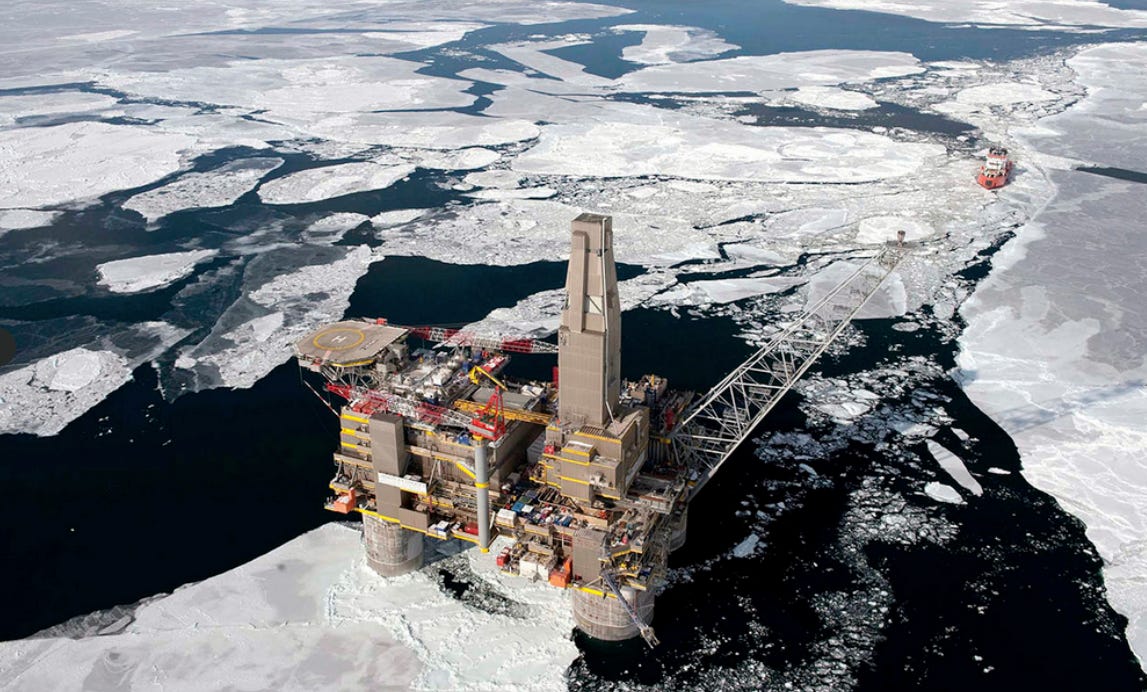
But 2012 wasn’t just about China’s Northern Sea Route transit and Arctic Council application. It was the year Western energy companies rushed into Russian Arctic drilling partnerships, essentially transferring the technology and capital Russia needed to dominate the region.
On April 25, 2012, in the presence of Prime Minister Vladimir Putin, Eni CEO Paolo Scaroni and Rosneft President Eduard Khudainatov signed a strategic cooperation agreement. Italy’s state-backed energy giant gained access to three massive Russian Arctic licenses. The Fedynsky license in the Barents Sea covered 38,000 square kilometers directly along the maritime border with Norway, with preliminary resource potential estimated at 18.7 billion barrels of oil equivalent. The Tsentralno-Barentsevsky license, also in the Barents Sea, and the Zapadno-Chernomorsky license in the Black Sea rounded out the deal. Eni took a 33.33% stake with Rosneft holding 66.67%. Scaroni called it “strategic for Eni as it will mark our exploration activities for many years.”
That same month, May 2012, Rosneft signed its third Arctic deal in thirty days. Norway’s Statoil, now Equinor, entered into Arctic exploration agreements for the Barents Sea. This was Norway’s state oil company partnering with Russia’s state oil company to unlock Arctic resources.
But the monster deal had been signed in 2011-2012 between ExxonMobil CEO Rex Tillerson and Rosneft CEO Igor Sechin. The agreement was valued at 500 billion dollars. It granted ExxonMobil access to the Russian Arctic with exemptions from export duties and property tax. Sechin declared it surpassed “projects such as the first spacewalk or flight to the Moon,” comparing the investment volume to developing the Brazilian shelf or the North Sea.
The payoff came quickly. In August 2014, exploratory drilling by the Rosneft-ExxonMobil joint venture Karmorneftegaz in the East-Prinovozemelsky-1 licensed area in the Kara Sea discovered an oil field with recoverable reserves of 130 million tonnes of oil and 500 billion cubic meters of natural gas. The companies calculated that single well could produce around 750 million barrels in its lifetime. The total Kara Sea estimate reached 90 billion barrels of recoverable reserves, more than any single Saudi Arabian oilfield.
This was the strategic contradiction of 2012. While Russia positioned militarily and China positioned diplomatically, Western governments remained asleep. Yet Western energy companies were racing to partner with Russia, providing exactly what Moscow needed: offshore drilling technology, artificial intelligence systems, special coatings and pipes Russia couldn’t produce domestically, and most importantly, capital.
Norway Sounds the Alarm
Norway, with its Arctic territory and direct border with Russia, watched this unfold with growing alarm. Since 2005, Norwegian governments had made the High North their highest foreign policy priority. The optimism of the early years, when cooperation seemed possible and the 2010 maritime boundary agreement with Russia appeared to herald a new era of relations, began to sour by 2014 with Russia’s Crimea annexation.
But Norwegian concerns predated the Ukraine crisis. As the United States published its first Arctic strategy in 2013 focused on climate change and governance, Norway was already recognizing the strategic competition taking shape. The Northern Chiefs of Defence Conference and the Arctic Security Forces Roundtable were established in 2011 and 2012 specifically to address Arctic security cooperation, an acknowledgment that military dimensions could no longer be ignored. The initiatives fell apart after 2014, but their creation reflected Norway’s earlier recognition of what was coming.
By 2016, during the Obama administration’s final year, Norway was openly expressing concern that the West was falling strategically behind in the Arctic. Norwegian defense officials and foreign ministry leadership saw Russia’s comprehensive military buildup, the reopening of Soviet-era bases, the expanded exercises and training operations, and the increasing pace of Northern Fleet activity. They watched China’s systematic investment and infrastructure development. And they recognized that while Norway maintained bilateral dialogue with Russia out of geographic necessity, the broader Western alliance was treating Arctic competition as theoretical rather than actual.
Norway’s geographic position made the threat immediate and undeniable. The Kola Peninsula, home to Russia’s nuclear capabilities and Northern Fleet headquarters, sits directly adjacent to Norwegian Arctic territory. Russian bomber patrols, submarine operations, and naval exercises were happening in Norway’s strategic backyard. The Svalbard archipelago, under Norwegian sovereignty but subject to the 1920 Svalbard Treaty granting signatory nations equal rights to economic activity, became a focal point for Russian pressure and testing of Norwegian resolve.
The Norwegian message to NATO allies during this period was direct: the Arctic was not some distant future concern. It was a present strategic reality requiring immediate attention. Russia was building capabilities, establishing presence, and demonstrating will. China was buying influence and positioning for long-term access. The West was debating environmental policy and assuming multilateral cooperation would continue. The gap between threat and response was widening.
This Norwegian assessment during the Obama years proved prescient. The United States remained focused primarily on Middle East counterterrorism and the Asia-Pacific pivot to counter China. The Arctic received policy attention in the form of the 2013 strategy, but implementation lagged dramatically. No icebreaker construction program materialized. No comprehensive Arctic military posture emerged. The regulatory and political environment remained hostile to domestic Arctic resource development. Climate change and environmental protection dominated Arctic discourse while Russia and China executed strategic plans.
Why the United States Fell Behind
The United States published its first Arctic strategy in 2013 under the Obama administration. The focus was explicitly on climate change and governance issues, not strategic competition. While Russia was signing half-trillion dollar drilling deals and reopening Arctic military bases, US policy treated the Arctic as an environmental concern requiring international cooperation.
The economic reality explains much of this divergence. Russia and China operate state-owned or state-controlled enterprises that can mask true costs through subsidies and strategic mandates. Russia’s history of using forced labor and state direction to conquer Siberia and the Arctic meant economic viability was never the primary consideration. The strategic and symbolic importance of Arctic control drove investment regardless of commercial returns.
For the United States, Arctic projects had to be profitable for private companies operating in a market economy. When Shell abandoned the Chukchi Sea in 2015 after spending six billion dollars and finding disappointing quantities of oil and gas, it demonstrated the commercial reality. High costs due to harsh conditions, regulatory requirements post-Deepwater Horizon, and environmental opposition made US Arctic development economically marginal at best.
The icebreaker gap told the infrastructure story starkly. By 2012, Russia operated over 40 icebreakers including seven nuclear-powered vessels. China was building its polar fleet. The United States had two aging icebreakers: the half-century-old Polar Star and one medium icebreaker. The Jones Act restrictions on foreign-built ships meant the US couldn’t quickly purchase proven icebreakers from Finland or Norway. Domestic shipyards lacked the specialized expertise, and building an icebreaker fleet from scratch would take decades.
Geography compounded the strategic asymmetry. Russia’s Arctic coastline spans 24,140 kilometers, over half the total Arctic coastline. Two million Russians live in the Arctic. The Northern Sea Route offers Russia’s first realistic year-round access to warm water ports, a geographic challenge that has shaped Russian strategy for centuries. For the United States, Alaska is strategically important but not existential. The primary focus remained the Middle East through the 2000s, then pivoted to countering China in the Indo-Pacific.
The policy mismatch was complete. While Russia executed comprehensive Arctic military and economic strategy and China systematically built Arctic presence and influence, the United States debated whether to allow drilling in ANWR, focused climate policy on Arctic ice melt, and treated the region as a multilateral governance challenge rather than a theater of strategic competition. Norway’s warnings during this period went largely unheeded. The United States was not prepared to treat the Arctic as a domain of great power competition while the Obama administration remained in office.
The 2014 Kill Switch and Russia’s Chinese Pivot
Russia’s annexation of Crimea in March 2014 changed everything. Western sanctions specifically targeted Arctic energy partnerships. ExxonMobil was forced to wind down Kara Sea operations, ultimately losing over one billion dollars. The company had to safely complete the already-started Arctic well and remove the rig, then cease all activity. Eni froze its Black Sea project, though the company maintained the partnership officially until 2018. Shell abandoned Arctic plans entirely in 2015. Statoil partnerships went dormant. The flow of Western technology, expertise, and capital to Russian Arctic development stopped.
Russia’s response was to pivot east. Chinese drilling rigs began operating on the Russian Arctic shelf. The Nan Hai IX, owned by China Oilfield Services Limited, and the Oriental Discovery, owned by Tianjin China State Shipbuilding Corporation, took over exploration work. Chinese investment flowed into Arctic LNG projects. The Yamal LNG project, which came online in 2017, included significant Chinese financing. Arctic LNG 2 became even more dependent on Chinese capital and technology after Western exit.
As one energy analyst described the pattern: “When a Russian project goes down, they run to the Chinese, and the Chinese buy it pennies on the dollar, squeezing the Russians really hard.” What appeared to be Russian-Chinese partnership was actually Russian dependence. Moscow needed the capital and technology. Beijing provided both, but on Beijing’s terms and at Beijing’s price.
The bilateral Arctic cooperation deepened. In April 2023, Russia’s Federal Security Service Border Service and the Chinese Coast Guard signed a memorandum of understanding strengthening cooperation. Joint naval exercises became routine. Chinese research vessels operated in Russian Arctic waters with increasing frequency. The Polar Silk Road concept incorporated the Northern Sea Route as a critical corridor for Chinese trade with Europe, potentially reducing shipping times by 40% compared to southern routes through the Malacca Strait.
China’s Arctic infrastructure buildout accelerated. Ground stations, satellite networks, the BeiDou navigation system providing polar coverage, and oceanographic research with obvious military applications all expanded. The comprehensive approach combined political engagement through the Arctic Council, economic investment in infrastructure and resources, scientific research providing dual-use capabilities, and gradual military presence through naval patrols and coast guard operations.
The Current Reckoning: Greenland 2025-2026
By 2022, the Biden administration published a new National Strategy for the Arctic Region explicitly focused on countering Russian and Chinese influence. The emphasis shifted from climate and governance to security and strategic competition. But the infrastructure gap remained enormous.
In July 2025, disaster struck what remained of US Arctic capability. The Coast Guard icebreaker Healy suffered an electrical fire during preparations for Arctic patrol, forcing it back to Seattle. The Polar Star had already entered dry dock for life-extension work. The entirety of America’s polar icebreaking fleet was sidelined simultaneously.
The embarrassment forced action. The United States announced the ICE Pact, the Icebreaker Collaboration Effort, with Canada and Finland in 2024. The partnership acknowledged what the icebreaker gap made undeniable: America couldn’t close the infrastructure deficit alone and needed allied expertise. The pact represented burden-sharing born of necessity rather than choice.
Then in January 2025, the second Trump administration renewed focus on Greenland. The strategic logic was undeniable. Greenland hosts Pituffik Space Base, formerly Thule Air Base, which provides critical early warning radar for NORAD. The island sits astride potential Northern Sea Route access. Rare earth deposits offer supply chain diversification from Chinese dominance. The geographic position controls Northwest Passage access and provides strategic depth for North American defense.
On January 17, 2026, President Trump announced 10% tariffs on eight European countries, Denmark, Norway, Sweden, France, Germany, the UK, the Netherlands, and Finland, over Greenland, with escalation to 20% or higher threatened by February. Treasury Secretary Scott Bessent explained the strategic imperative bluntly: “Greenland is essential to US national security. President Trump is being strategic. He’s looking beyond this year, he’s looking beyond next year, to what could happen for a battle in the Arctic. We are not going to outsource our national security.”
The statement was an admission. For 15 years, from 2008 to 2023, the United States effectively did outsource Arctic security. Policy treated the region as an environmental challenge requiring multilateral cooperation while Russia militarized, China invested, and Western energy companies transferred the technology Moscow needed. The 2014 sanctions disrupted Western-Russian partnerships but created the vacuum China filled. Norway had been sounding the alarm throughout the Obama years about the West falling behind, but the warnings were not translated into substantive strategic response. Now in 2026, facing Russian Arctic dominance, Chinese strategic presence, and massive infrastructure deficits, Washington was acknowledging the reality Norway had recognized a decade earlier.
The Strategic Failure and What It Cost
The pattern was clear from 2007 forward. Russia declared Arctic strategic priority, resumed military presence, established comprehensive policy frameworks, and sought Western capital and technology to unlock resources. China methodically built presence through observer status, infrastructure investment, research stations with dual-use capability, and partnership with Russia. Western energy companies saw commercial opportunity and provided technology transfer. Norway and other frontline Arctic states saw strategic competition emerging and tried to sound the alarm. Western governments saw environmental concerns and governance challenges.
The cost of this strategic mismatch became evident by 2026. Russia operates over 40 icebreakers including seven nuclear-powered vessels and has modernized Northern Fleet capabilities. China operates four icebreakers with more under construction, has observer status it leveraged aggressively, maintains ground stations across Nordic nations, and treats the Northern Sea Route as Belt and Road infrastructure. The United States has two aging icebreakers frequently offline, no comprehensive Arctic shipbuilding executed, delayed NORAD modernization, and is now in a tariff dispute with Denmark over Greenland.
The infrastructure tells the story. Russia reopened Soviet-era bases across its Arctic coast, established the Arctic Military Command, built Northern Sea Route ports and support facilities, and committed 19 billion dollars to Arctic development through 2035. China built ground stations from Svalbard to Greenland, deployed polar satellite constellations, invested tens of billions in Russian Arctic energy projects, and positioned the region as critical to its maritime great power ambitions.
The permissive environment that allowed this is ending, which is precisely Bessent’s point. For 15 years the West treated Arctic competition as theoretical while Norway and other Arctic nations tried to make clear it was already underway. Russia and China treated it as inevitable and positioned accordingly. The geographic absurdity of China as a “near-Arctic state” succeeded because it went unchallenged. The technology transfer through ExxonMobil, Eni, and Statoil partnerships gave Russia capabilities it couldn’t develop domestically. The infrastructure gap in icebreakers, ports, bases, and Arctic-capable systems created dependencies that are now strategic vulnerabilities.
The 2012 drilling deals represented the peak of this strategic contradiction. Russia was signing half-trillion dollar agreements with Western majors while simultaneously executing military Arctic expansion and declaring NATO the primary threat in the region. The West saw commercial opportunity. Moscow saw technology acquisition and capital extraction to build strategic dominance. When sanctions hit in 2014, the Western companies lost billions and market access. Russia pivoted to China and continued development. The strategic winner was clear.
Bessent’s statement about not outsourcing national security is recognition that’s exactly what happened. The battle for the Arctic isn’t coming. It’s been underway since 2007 when Chilingarov planted that flag. Norway recognized this during the Obama administration and tried to warn its allies. We just called it climate change, governance, and commercial opportunity while Russia called it strategic imperative and China called it the Polar Silk Road. Now we’re 19 years behind in infrastructure, influence, and presence, scrambling to build icebreakers and threatening tariffs over Greenland because the permissive environment where the Arctic was treated as a cooperative zone is gone.
The Arctic race is far from over, but the competitors who understood from the beginning it was a race now hold commanding advantages. That clarity of strategic vision, sustained over nearly two decades, created the current reality where Russia dominates Arctic military presence and infrastructure, China has positioned itself as indispensable Arctic stakeholder despite no Arctic territory, and the United States is finally mobilizing after years of treating the region as a climate and governance challenge. The scramble for icebreakers, the ICE Pact with allies, the Greenland focus, and Bessent’s stark admission about not outsourcing national security represent not surrender but belated recognition of what Norway tried to tell us during the Obama years.
The question now is whether the United States and its allies can close a gap that’s been widening since 2007. Russia and China have 15 to 19-year head starts in infrastructure, presence, and strategic positioning. They own critical ground, know the waters, and have built the systems and relationships that confer influence. But the Arctic is not lost. The race is entering a new phase where the permissive environment of assumed cooperation is gone, replaced by explicit great power competition. The West has geographic advantages through NATO Arctic members, superior technology in many domains, alliance structures Russia and China cannot match, and finally, political will that was absent for nearly two decades.
The battle for the Arctic that Bessent describes isn’t hypothetical future conflict. It’s the ongoing competition for infrastructure, influence, access, and ultimately control over a region that will define northern hemisphere security for the rest of the century. The United States let that competition proceed for 15 years while Russia and China positioned. We’re behind, the deficit is real, and closing it will require sustained investment and strategic focus we haven’t demonstrated yet. But recognizing you’re in a race is the first step to competing in it. The question is whether recognition came too late, or just late enough to still matter.


The repetitive style of most articles here always had a taste of AI generation, but since the overall content was reasonable I attributed this to personal style.
Sadly, I was wrong, a we can see here with even the prompts posted (in the original emailed version). It really is a shame, why do you deceive your paying readers like this?
I appreciate writing is not easy, but then make it short and to the point instead of having AI churn out endless paragraphs.
Thank you for this great article